

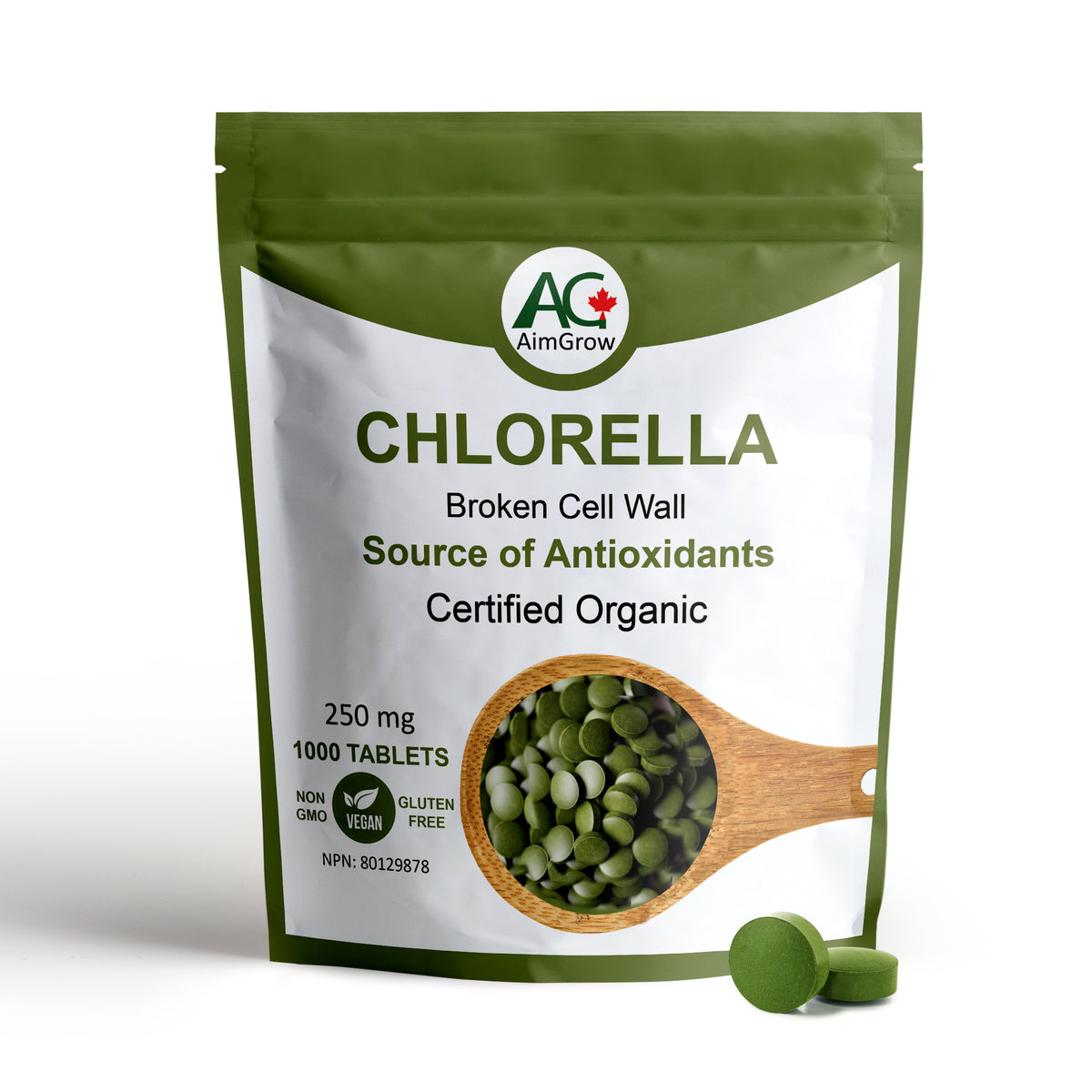
If you search for organic chlorella tablets, it is easy to stop at the word “organic” on a product image. But a useful check starts one step earlier: which exact pack are you looking at? AimGrow currently has separate listings for 500 mg, 300-count chlorella tablets and 250 mg, 1,000-count chlorella tablets. The listing names make it possible to ask a precise question about the product you might buy.
This guide shows you how to connect a listing, a physical label and any documents a seller supplies. It does not independently certify either current pack or lot. Photos and archived certificates are starting points, not proof that the next pack shipped to you has the same label or a currently valid certification.
First, identify the product in your cart
Open the live listing and copy its full name. Note the tablet amount and pack count separately. A 500 mg tablet in a 300-count pack is a different listing from a 250 mg tablet in a 1,000-count pack. Those numbers describe a tablet and a container; neither is a personal serving instruction. For the practical comparison, see our 250 mg versus 500 mg chlorella tablet guide.
Next, check the current physical label when the pack arrives. Look for the ingredient list, directions, warnings, lot number and expiry date. If you have not ordered yet and a label panel is hard to read online, ask AimGrow for a current label for the exact listing. This is more useful than relying on a small front-of-pack photo.
Ask for the right kind of evidence
AimGrow has a certifications and documents page with links to organic and other files. Its own guidance says to check the named company or facility, product scope, date and validity, and to request current documents for the exact product and supplied lot. A file in a general library does not answer every question about a specific retail pack.
There are three different things you may need:
- A current product label. This tells you what the pack says about its ingredients, directions, warnings and identity. It does not by itself prove a claim made by a separate certificate.
- An organic certification document. Check the certifier, operation, scope, dates and market. Ask how that document covers the finished product in your cart. A facility-level document or an old image may not settle that question.
- A lot-specific certificate of analysis, if batch testing matters to you. This should identify the supplied lot and report the relevant test results, limits, methods and dates. It answers a different question from organic certification. Do not treat a general certificate as a substitute for lot results.
You do not need to become a laboratory auditor to shop responsibly. You just need to know what each file can show, then ask for the one that matches your question.
Check the market as well as the logo
In the United States, the USDA organic labeling guide explains the categories and rules for organic claims. In Canada, the Canadian Food Inspection Agency’s organic-claims guide explains the Canada Organic Regime for imported or interprovincially traded products. A logo or certificate from one context should not be read as a blanket answer for every market.
If you are purchasing for a specific country, include that country in your document request. Then compare the document’s actual wording and scope with the current product label. Our broader organic chlorella label guide explains what the word “organic” does and does not tell a shopper; here the key step is matching the claim to this exact tablet pack.
A useful message to send before buying
If the documents are not clear, send a short question through AimGrow’s contact page:
I am looking at the AimGrow Organic Chlorella Broken Cell Wall Tablets [250 mg/1,000 count or 500 mg/300 count] listing for [country]. Could you send the current label and the organic certificate that applies to this exact finished product? Please tell me the certifier, covered product or operation, and validity date. If I share a lot number after purchase, can you provide the relevant lot-specific analysis?
Replace the brackets with your own details. The lot number belongs to the pack you actually receive; do not guess one from a gallery image. If the seller cannot yet identify the supplied lot, ask what documentation will accompany your order.

Keep the claim in its lane
Organic certification concerns the applicable production and handling standards. It is not a promise that tablets “detox” the body, treat a condition, or work better than non-organic tablets. Likewise, “broken cell wall” is a processing description; the phrase alone does not establish a personal health result. If you care about a health outcome, look for relevant human evidence and discuss your circumstances with a qualified clinician.
Before checkout, use the current product page for stock, price, shipping and returns. Both AimGrow tablet listings displayed “Sold Out” when this article was researched on 11 November 2026, and availability can change. Do not make a purchase decision from an old screenshot. If you want tablets but these two packs are unavailable, ask the store which current format it can supply and check that format’s own label.
Quick questions
Does an organic certificate cover every AimGrow chlorella tablet pack?
Do not assume so. Read its scope and dates, then ask how it applies to the exact finished product and market you are considering.
Is a lot-specific test report the same as an organic certificate?
No. They answer different questions. A lot report should identify and test the supplied batch; an organic certificate addresses the applicable organic standards and covered operation or product.
Does 300 count mean 300 servings?
No. It is the number of tablets in the 500 mg pack. The current pack directions determine how the product is to be used.
What if I already have a pack?
Use the product name and the lot number printed on your own pack when asking AimGrow for batch-specific documents. Check its actual expiry date, directions and warnings before use.