

If a chlorella tablet says “broken cell wall,” that wording describes the ingredient’s processing before or during manufacture. It does not tell you how many cells were opened, how the finished tablet was tested, or what a person will absorb from a labelled serving. The useful shopping question is: what evidence belongs to this exact tablet product?
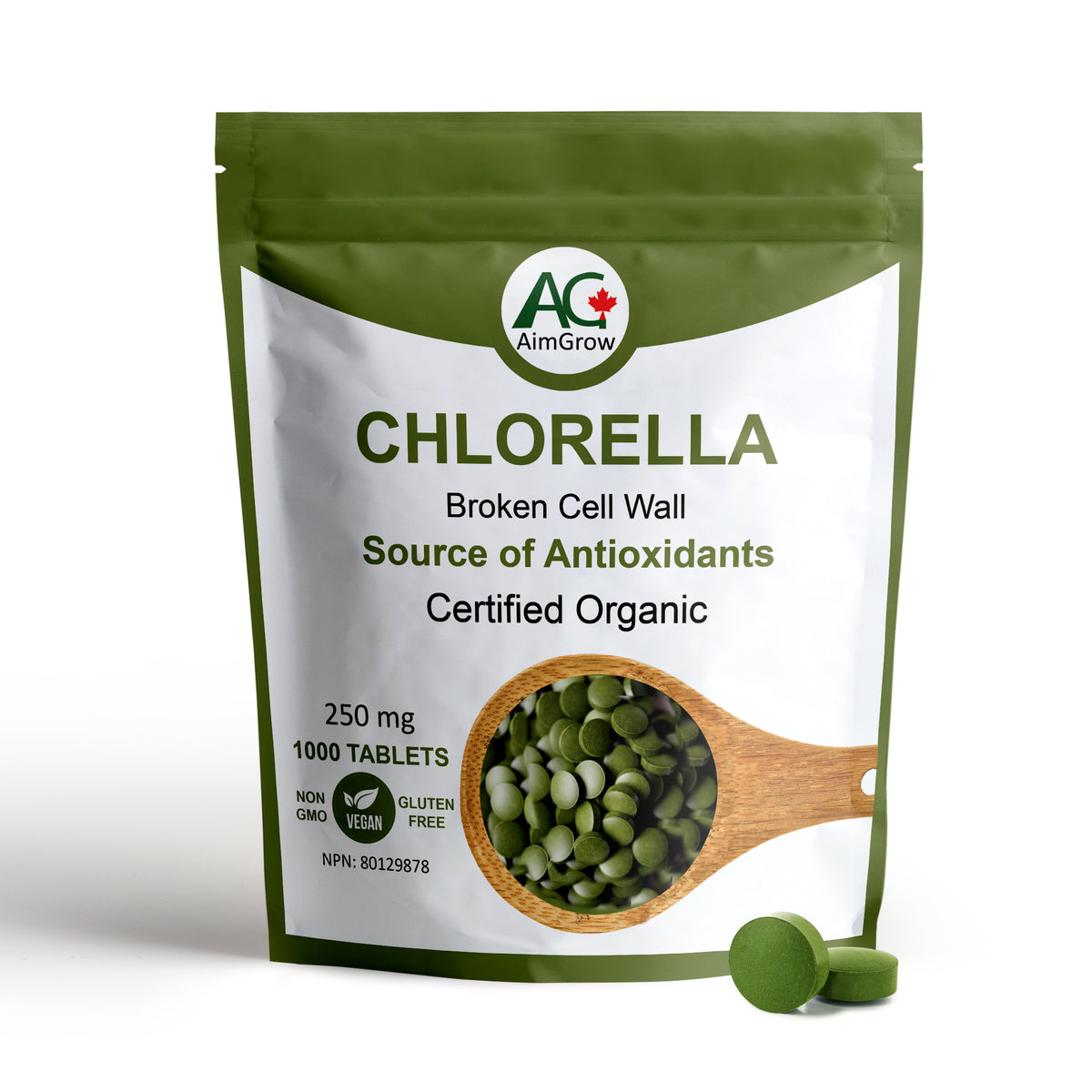
AimGrow currently has two separate organic broken-cell-wall chlorella tablet listings: 250 mg per tablet, 1,000 counts and 500 mg per tablet, 300 counts. The listings identify the format, amount per tablet and pack count. They do not publish a verified cell-disruption percentage or prove that the finished tablets were used in a human trial. Check the current package for its ingredients and directions.
What happens before a tablet reaches your hand?
Chlorella is a microscopic green alga with a cell wall. Manufacturers may physically process dried biomass to disrupt the cells, then make a powder or compress it into tablets. The tablet’s dark-green appearance cannot show how much disruption occurred. Nor can you diagnose it by dissolving a tablet in a glass; visible breakup of a tablet is a different question from microscopic disruption of cells inside it.
Our plain-language broken-cell-wall explainer covers the general concept using a powder pouch. For tablets, an extra distinction matters: “broken cell wall” concerns the chlorella ingredient, while “tablet dissolves” concerns the finished dosage form. One does not prove the other.
What does research actually show about disrupted chlorella?
In a 2020 rat study, mechanical cell-wall disruption improved protein digestibility for three studied green microalgae, including Chlorella vulgaris. That supports a reason to investigate processing; it is not a measured benefit for either AimGrow tablet SKU or a prediction of a person’s absorption.
A small 2024 randomized crossover study in 10 young adults compared drinks made from whole-cell and split-cell chlorella, spirulina and milk protein. Each test drink supplied 20 g of protein plus carbohydrate. The split-cell condition’s amino-acid response was numerically higher than whole-cell chlorella, but the reported comparison did not meet the conventional threshold for statistical significance (P = 0.09). The study tested drinks, not a retail tablet pack, and it did not measure a “detox” outcome.
This is why “broken cell wall” is best read as a processing description, not “100% absorbed.” A reported result from a different species, amount or format cannot be transferred directly to your bottle.

Questions worth asking for the exact SKU
Which chlorella ingredient is in this pack? Ask for the current label of the 250 mg or 500 mg product you are considering, including its full ingredient list and directions. Do not assume the two products use identical formulations because they share a phrase in the title.
What processing evidence exists? If a disruption percentage matters to you, ask AimGrow whether the exact ingredient or finished tablet has a documented method and result, what method was used, and whether the document covers the product being sold. A general research paper establishes what a method can do in a study, not that a specific lot meets that result.
What does a lot report cover? If you already have a pack, use its lot number when requesting a batch-specific certificate of analysis. Confirm that the report identifies the relevant product, tests, dates and acceptance limits. A routine contaminant test can be useful quality information without being a cell-wall-disruption test. AimGrow’s certifications and documents page is a starting point for asking for the right file.
What does the label tell me about use? The 250 mg and 500 mg numbers are per-tablet amounts, not personal doses or protein amounts. Pack count is not a serving count unless the label’s directions make it so. If you need a counted-format comparison, see our 250 mg versus 500 mg guide.
Is broken cell wall the same as a tablet dissolving quickly?
No. The first refers to the microscopic chlorella cells; the second refers to the compressed tablet as a whole. A glass-of-water demonstration cannot quantify either process in your digestive system.
Do I need to break or crush these tablets myself?
Do not assume so. The processing phrase refers to the ingredient, not an instruction for you to crush a finished tablet. Follow the current package directions. If swallowing or use is difficult, ask a pharmacist or other qualified professional about a suitable option.
Does this label prove a health benefit?
No. Processing research may inform how nutrients become accessible, but a clinical benefit requires relevant human outcomes for a sufficiently comparable product and amount. Our chlorella tablets benefits guide explains how to read those claims.
Practical next step: Open the live 250 mg or 500 mg AimGrow listing, confirm the exact pack, then ask for its current label and product-specific processing documentation if the phrase affects your purchase.